
Schedule
Board United flight in Fresno at 7.27 AM and arrive in San Francisco at 8.36 AM. From Terminal 3 board Air India flight at 9.45 AM.
Arrive in Indira Gandhi International Airport in New Delhi at 7.45 PM. Traditional Welcome with marigold garlands and transfer to The Taj Mahal Hotel in New Delhi, a 5-star luxury hotel in the heart of the city, known as a landmark with views of Lutyens Delhi, close to India Gate, Parliament, Prime Minister’s office, President’s residence etc. It features elegant rooms, diverse dining options, and amenities like a swimming pool and spa, blending classic style with modern luxury. The hotel is close to cultural sites, making it a distinguished address in the capital. The hotel is celebrated for providing a luxurious and attentive experience, making it a top choice for travelers seeking comfort and quality in the heart of the city. Overnight in Taj Mahal Hotel on Mansingh Marg (5-star deluxe).
After breakfast in hotel, Sightseeing of Qutub Minar minaret and the mosque (a UNESCO World Heritage Site). Its construction was started by the first Islamic Sultan of Delhi, Qutubuddin Aibak in 1198 CE. Qutubudin-Aibak was born in Turkestan of ethnic Mamluk descent. This was a region where youth went out to neighboring countries and joined their armies as mercenaries. They were enslaved when the army they were fighting with lost. Qutbuddin was sold to the Qazi (Islamic judge) of Nishapur in Persia. There he became favorite of his master because of his skills of horse-riding and archery among other warrior abilities. Qazi’s sons were jealous and they sold him after the Qazi’s death. He ended up as slave of Sultan Muhammad of Ghur province of Afghanistan. He led Sultan of Ghur’s army in the 1st and 2nd battle of Tarain and was appointed Governor of Lalkot, the capital of the last Hindu Chauhan dynasty kingdom. When Muhammad of Ghur was assassinated, Qutubudin-Aibak declared himself sovereign monarch and started the construction of Qutub Jami Mosque (a.k.a. Quwwat ul Islam Mosque) and Qutub Minar. The construction of minaret did not complete in his lifetime and many later Islamic rulers of various successive dynasties left their mark on this monument, which is now 5 stories high and 73 meters or 240 feet tall. The mosque was constructed using architectural elements of 27 Hindu and Jain temples that were demolished to build it. Much of the decorative pillars and facades of walls in the mosque were used without alteration in the new mosque, only the Arabic verses from the Quran were added new, sculpted by Hindu artisans who did not know the Arabic language and curved the endings of letters as they did with Sanskrit language carvings.
Later sightseeing of the Second Mughal Emperor Humayun’s Tomb – its architecture may have influenced the construction of the Taj Mahal in Agra. Emperor Humayun died just six months after winning the throne of Delhi in 1556 CE. His widow, Hamida Bano Begum (a.k.a. Haji Begum) supervised its construction under Mughal Emperor Akbar’s rule. Having recently returned from Persia and its architect, Mirak Mirza Ghiyath, being a Persian, the monument has elements of Persian and Hindu architecture blended in it. Many later Mughal rulers are also buried in this mausoleum. Humayun’s Tomb is a UNESCO World Heritage Site. Later drive to the India Gate war memorial for a photography stop. Drive past the government buildings of the British colonial period.Lunch will be in an exclusive New Delhi city restaurant. In the afternoon drive to the Red Fort (Lal Qila) in Delhi is a 17th-century fort built by Mughal Emperor Shah Jahan, known for its massive red sandstone walls and a complex of pavilions, palaces, and gardens designed with ornate Mughal and Persianate architectural styles. Key features include the Diwan-i-Am (Hall of Public Audience) and Diwan-i-Khas (Hall of Private Audience), linked by the Nahr-i-Behisht (Stream of Paradise). It now serves as a UNESCO World Heritage Site and the location for India’s annual Independence Day flag-raising ceremony. It was designated a UNESCO World Heritage Site in 2007, recognizing its global cultural importance. After extensive sightseeing of the Red Fort, a short drive further in to the heart of old Delhi (called Shahjahanabad during the 5th Mughal Emperor’s reign and later) is another massive monument built by the same Emperor, the Jama Masjid (Friday Mosque). Enjoy a thrilling cycle rickshaw ride in the narrow, busy lanes of the old Delhi bazaar near Chandni-chowk Bazaar. Dinner and overnight in The Taj Mahal Hotel.
Transfer to New Delhi airport to board the flight to Kathmandu. On arrival transfer to the Aloft Kathmandu Hotel in Thamel area of Kathmandu.
Later proceed for sightseeing of Boudha Nath Stupa – the world’s largest stupa. a sight of great veneration to the Buddhists, is a colossal stupa north east of Pashupatinath. The origin of this stupa is rather obscure. A legend says that a woman named Kangma was banished from heaven by Indra for stealing flowers and was reborn on earth as a swineherd’s daughter. Rearing and selling geese, Kangma accumulated a considerable amount of wealth. One day, she went to request the king for a plot of land to build a temple dedicated to the Buddha Amitabha. She asked that she be given land the size which a buffalo’s hide would cover. The king agreed to what he thought was a harmless request, but Kangma very shrewdly cut the hide making it into one very long strip of leather. Stretching it out to form a very large circle. She asked for and was given this huge plot where Boudhanath stands today. Dinner and overnight in Aloft Kathmandu Hotel.
After breakfast in hotel, full day tour of Patan & Bhaktapur-Nagarkot. Sightseeing tour of the Patan – a city of heritage wooden architecture and fine arts. Visit Tibetan Handicraft center at Jawalakhel to watch carpet weaving. Patan Durbar Square complex, situated in the center of Patan city, also known as Lalitpur, houses the residence of the former Patan royal family. Patan Square and its surroundings are good specimen of ancient Newari architecture. There are three main courtyards in the palace: Mul Chowk, Sundari Chowk and Keshav Narayan Chowk. Mul Chowk, the oldest one, is at the center of Patan square. Several multi-sized and multi-styled temples occupy the western part of the complex. Main among these are Krishna Temple, Bhimsen Temple and the Golden Temple of Hiranya Varna.
Bhaktapur – Kathmandu valley’s most medieval city also known as Bhadgaon and was one of the three Kingdoms of Mallas. It is famous for Lion gate, the picture gallery, the Golden gate and palace of 55 windows. Lunch break in Bhaktapur before sightseeing and finally transfer to Nagarkot for sunset view of the entire range of eastern Himalaya mountains. Lunch will be in a city restaurant during the sightseeing.
Nagarkot is situated 32 km east of Kathmandu at an altitude of 2175 meters above sea level. Nagarkot is a popular tourist spot of Nepal. The panorama of the major peaks of eastern Nepal Himalayas including Sagarmatha (Mt. Everest-if weather permits), can be seen from here). The Himalayan peaks Like Manaslu (8463 meters). Ganesh Hinial (7111 meters), Langtang (7246 meters), Choba Bhanre (6016 meters), and Gaurishanker (7134 meters) are all visible from Nagarkot in clear sky). Dinner and overnight at Club Himalaya by Ace Hotel in Nagarkot.

After sunrise view of Himalayan Mountain peaks and breakfast, drive back to Kathmandu. Sightseeing of Pashupatinath Temple – the most sacred of the Hindu temples in Nepal dedicated to lord Shiva, first established in 5th century. The holiest Hindu pilgrimage place in Nepal Pashupati has received the attention of worshippers for at least fifteen hundred years. Dedicated to Shiva, the temple is situated on the banks of the Bagmati river. A circuit of the Pashupati area takes visitors past a sixth century statue of the Buddha an eighth century statue of Brahma the Creator freshly painted skeletal images guarding temple gates, and other magnificent temples dedicates to various deities in the complex.
Swayambhu Nath – the oldest Buddhist shrine. Looking east from here, one can see the entire Kathmandu valley spread out below. Swayambhu Nath is a best place to observe religious harmony between Nepalese Buddhists and Hindus. The stupa is one of the most ancient in this part of the world and its worshippers come from diverse ethical backgrounds. Situated on the top of a hill, it provides an excellent view of the Kathmandu Valley. Huge prayer wheels and fine Buddhist paintings are displayed in the monasteries as well as the largest Buddha statue in the country. Special butter lamps can be lit after monetary gifts are offered to the images.
Lunch stop in Darbar Square. Kathmandu Durbar Square – the temple of the Living Goddess and the old Royal Palace. Finally, visit Kastamandup – a temple built from a single tree from which the city of Kathmandu derives its name. The Square teems with life as vendor’s, children, tourists and other crowed around the temple of the Living Goddess Kumari. Goddess Taleju and the Kastamandap Resthouse: many pay homage to the monuments of Kal Bhairab Lord Hanuman and to the images of Shiva and Parbati. The buildings here are the greatest achievement of the Malla dynasty and they resulted from the great rivalry between the three palaces of Kathmandu Patan and Bhaktapur. Most wood carvings statues and architecture in this area are exceptionally fine.
Kathmandu became the seat of Valley’s royalty when King Jayasthiti Malla unified the valley in the 14th century (although it was divided later by his descendants). The Malla kings’ royal palace was located at Hanuman Dhoka, and it was retained as the ceremonial palace of the former kings. Although the King Birendra did not reside there, important traditional royal ceremonies including the crowning of the king were conducted at Hanuman Dhoka. Hanuman Dhoka (literally, Hanuman Gate) takes its name from the monkey god Hanuman, whose idol lies at the entrance of the palace. Kneeling in his usual posture on a pedestal, Hanuman is a hero from the Hindu epic Ramayana, who endows military success to his devotees – the reason why he has been placed there. Transfer to Aloft Kathmandu Hotel. Evening dinner with cultural show.
Optional at extra $ 300 – Mount Everest Flight (only if sky is clear): Early morning before breakfast drive to domestic airport at about 5 AM. Starting between 6.30 and 7.30 AM the flight takes about 50 minutes. One views the Mount Everest façade from a distance of about 20 kilometers. Experience the awesome and unforgettable sight of Mount Everest in close-up, on this flight. All the peaks in Himalayan mountains near Mount Everest are visible in this flight. Then transfer back to hotel.

Later transfer to international airport for boarding the Nepal Airlines flight RA217 departing at 1.45 PM and arrive in Delhi at 3.15 PM. Transfer by air-conditioned coach directly from airport to Oberoi Amar Vilas Hotel, located just about 2000 feet from east gate of the Taj Mahal – each of its 102 rooms has a view of the Taj Mahal. On arrival check-in, dinner and overnight in Oberoi Amar Vilas Hotel (5-star deluxe).
Before sunrise experience the highlight of any India tour, the Taj Mahal in the golden glow of sunrise. Ample time in the vast complex for photographing and viewing the intricate Pietra Dure (inlay of semi-precious stones in marble art work, used in the exterior and interior of the monument.
Prince Khurram (later Emperor Shahjahan) and his father Prince Salim met their favorite future queens in a mock market called Meena Bazaar to celebrate the Persian new year festival of Nowruz in Agra Fort. Prince Salim wanted to marry Mehr un Nissa Begum, the daughter of Mirza Ghiaz Beg but Emperor Akbar did not want Shi’a influence in the royal family so he asked Mirza Ghiaz Beg to marry his daughter to an Afghan commander and had him posted in Bihar. Prince Khurram was third eldest and not initially in direct line of succession. He was betrothed to Arjumand Bano Begum on April 5, 1607 but Prince Salim delayed his marriage. After death of Emperor Akbar, Prince Salim ascended the throne with the title of Emperor Jahangir and it was only in May 1610 that Mehr un Nissa, the widow of the Afghan commander finally agreed to marry him. He honored her with the title of Nur Jahan (light of the world) after his marriage. One year later on May 10, 1612, Prince Khurram was finally allowed to marry his beloved Arjumand Bano Begum, who was the niece of Mehr un Nissa (her brother’s daughter and granddaughter of Mirza Ghiaz Beg). She received the title of Begum Mumtaj Mahal after her marriage with the Mughal prince. Begum Mumtaj Mahal was 19 years when they married. She was his constant companion and most trusted advisor. During their 19 years of marriage, she gave birth to 14 children of which only 3 daughters and 4 sons survived. The youngest son, Aurangzeb fought a war of succession against his elder brothers. One after the other he won against all of them, had all the brothers killed and then put his father, Emperor Shahjahan, under arrest in his own palaces in Agra Fort. Queen Mumtaj Mahal died on June 17, 1631 while delivering her 14th child, a daughter, Gauhar Ara Begum, who survived and lived in Shahjahanabad to a ripe age of 75 years.
The site of the Taj Mahal mausoleum was a palace of the Maharaja of Amber, Mirza Raja Jai Singh. The emperor asked him to give the palace and grounds back to him and gave him other properties in lieu. The queen was temporarily buried in Burhanpur where she died in. The body was transferred to Agra and again temporarily buried in the northwest section of the garden of Taj Mahal where a red sandstone enclosure still marks the site of her temporary burial. The Taj Mahal mausoleum was completed in 1648 according to an inscription on its main gate. The tomb was built exclusively for Queen Mumtaj Mahal, so her grave stone is in the center of the grave chamber. Emperor Shahjahan died on January 16, 1666 in Mussamam Burj Palace in Agra Fort. He was buried by the queen’s side and his grave stone is the only architectural feature in this mausoleum that is not symmetrical. Taj Mahal, is a UNESCO World Heritage Site.
After breakfast enjoy a demonstration of the art of Pietra Dure (inlay of semi-precious stones on marble surface) at Agra’s oldest emporium where the not for sale section has some artifacts with inlay work much finer than the most intricate art work in the Taj Mahal itself and perhaps the world’s best.
In the afternoon sightseeing of Agra Fort. Emperor Akbar moved his capital to Agra from Delhi in 1558 but the construction of the Agra Fort started in 1565. It was built on the ruins of an earlier fort named Badalgarh. The first Mughal Emperor Babur had occupied this fort after his victory in the battle of Panipat in 1526 CE. His son, second Mughal Emperor Humayun was crowned in the old fort of Badalgarh in 1530. With about 4000 laborers and craftsmen toiling for 8 years the fort’s construction was completed in 1573. The entire fort was built with narrow flat brick masonry work and laminated with red sandstone from the stone quarry at Sikri village west of Agra. According the Emperor Akbar’s official biography written by his trusted friend, Abul Fazl, there were about 5000 buildings in the fort. Some of these buildings were demolished to make way for white marble palaces of Emperor Shahjahan, facing the Yamuna River, on the eastern side of the fort. Most of the buildings in western side were converted in to soldier’s barracks by the British East India Company. The western part of the fort is still occupied by Indian military. Emperor Akbar’s style was greatly influenced by the architecture of the states of Gujarat and Bengal. It is also very unique because it reflects Emperor Akbar’s tolerant religious philosophy. The best of example of his architecture is visible in the palace popularly called Jahangiri Mahal. In 1666 the great Maratha warrior, Shivaji met with Emperor Aurangzeb but the Mughal Emperor broke his promise and arrested him. He managed to escape in a spectacular manner by hiding in fruit baskets for distribution to poor. The Jat and Maratha rulers occupied Agra Fort in later years. Finally in 1803 the British East India Company captured it and demolished most of its monuments, only about 30 monuments have survived in the south-eastern side of the fort. In 1983 the Agra Fort was declared a UNESCO World Heritage Monument.
Later sightseeing of the Tomb of Itmad-ud-Daulah. This is the mausoleum built under supervision of Empress Nur Jahan for her parents, Mirza Ghiaz Beg and Begum Asmat in 1628 CE almost 7 years after her father’s death. Mirza Ghiaz Beg received the title of Itmad-ud-Daulah or ‘Lord of Treasure of the Empire’ from Emperor Jahangir. Upon arrival check in to the hotel.
On the way to hotel wonder at the largest collection of Zerdozi Embroidery Art in India. This embossed embroidery art is attributed to the Mughal Empress Nurjahan. It uses silver, gold and colored silk thread embroidery on silk and velvet background and is one of the unique arts originating in Mughal period. Dinner and overnight in Oberoi Amar Vilas Hotel (5-star deluxe).
After breakfast drive one hour to Fatehpur Sikri for sightseeing of Mughal Emperor Akbar’s deserted capital and the tomb of Sufi saint Sheikh Salim Chishti in the courtyard of the grand mosque. Emperor Akbar did not have a male heir to his throne for a long time. He came to the Sikri village to seek the blessings of the Sufi saint, Sheikh Salim Chishti, who correctly prophesied that Emperor Akbar would have three sons. The emperor moved with his Hindu queen, Jodha Bai, to Sikri village to live with the saint and started building an alternative capital at the site which was earlier a query for red sandstone. The entire capital was built with red sandstone from the ridge on which it is located. The first-born son was named Salim after the Sufi saint. The second was named Murad or the longed one. The third son was named Daniel, probably influenced by the Jesuit priests from Goa who were invited by the emperor to teach him about Christianity. Emperor Akbar developed the philosophy of “Sulah Qul” – living in harmony with all religions. Later he developed his own religion, Din-i-Ilahi or faith of God. His dear friend and official biographer, Abul Fazl, was among the first to convert to the new religion which he described in “Akbar Nama”. Visit the grand Friday “Jama Masjid” and the mausoleum of Sheikh Salim Chishti, which was renovated using the white marble by later Mughal Emperors. After Emperor Akbar moved away from this capital, living there only 14 years, the capital was deserted for more than 400 years until Lord Curzon, British Viceroy of India ordered the Archaeological Survey of India to restore this fascinating capital and this renovation work is still going on. The palaces were all covered with wild forest and wild animals lived in the palaces. The “Dargah” or mausoleum of the saint was never deserted and people from Agra and nearby villages have been coming there to seek the saint’s blessings for centuries. The entire archaeological site of palaces and the mosque were declared a UNESCO World Heritage Site in 1986.

After lunch in Bharatpur, drive further to Jaipur. JAIPUR CITY was declared a UNESCO World Heritage City in 2019. The Jai Mahal Palace is a historic, 5-star luxury hotel in Jaipur, India, built in 1745, it was originally the garden residence of the Army Chief of the Jaipur kingdom. Later it served as the official residence of the Prime Minister of Jaipur kingdom. Since 1984 the Taj Group of Hotel manages this palace. Set on 18 acres of landscaped Mughal gardens, it offers 100 rooms and suites with a colonial style and regal ambiance. The hotel features multiple dining options, a pool, a health spa, and is known for its family-friendly facilities, including an activity room, swimming pool, and game areas. In the late afternoon explore the cutting and polishing of colored precious stones and wood block printed textiles. Dinner and overnight stay in the Taj Jai Mahal Hotel in Jaipur.
After breakfast full day sightseeing of Amber and Jaipur starting with a drive through the walled pink city to Hawa Mahal, which is mere facade with about 3 feet deep balconies behind latticed screens where royal family women used to sit to watch the royal processions on the street.
Drive further north through pink city to Amber Fort to enjoy a majestic elephant ride to the hilltop palaces of Sawai Jai Singh, Mirza Raja Jai Singh and Maharaja Man Singh (one of nine jewels of Emperor Akbar’s cabinet of nobles). On the way back stop at the Jal Mahal Island Palace.
Lunch will be in Peacock Restaurant at Hotel Pearl Palace.
Jaipur City was designed by Maharaja Sawai Jai Singh and his principal architectural and city planning advisor, Vidhya Dhar Bhattacharya. On July 6, 2019 the entire walled and painted pink city has been declared a UNESCO WORLD HERITAGE SITE.
In the afternoon visit the City Palace including the Royal portraits gallery in the Diwan-i-Am (Hall of Public Audience), the Diwan-i-Khas (Hall of Private Audience), the Mor Chowk (peacock) courtyard of Chandra Mahal, the palace where the present head of the Jaipur royal still resides. When he is in the building the family’s royal flag flies on its roof.
For our group there will be a special tour of the personal palace of the present head of the Jaipur Royal Family, Chandra Mahal. Normally this is closed to general public and tourists.
Later wonder at the 16 working astronomical instruments of the Jantar Mantar observatory of Maharaja Sawai Jai Singh. The Brihat Samrat Yantra (large sundial) here has an accuracy of 2 seconds. This masonry astronomical observatory is the largest and best maintained of the five observatories constructed in Ujjain, Varanasi, New Delhi and Mathura. The observatory in Mathura was demolished in the colonial British East India Company period. Dinner and overnight in Taj Jai Mahal Hotel (heritage 5-star deluxe).
After breakfast in Taj Jaimahal Palace, transfer to Mumbai domestic airport to board Air India flight departing at 9.30 AM and arrive in Mumbai at 11.40 AM. Transfer to the Taj Mahal Palace & Tower Hotel. The older part of the hotel was built in 1903. Next to it was originally the Greens Hotel that was constructed in 1890 and operated by Tata Group from 1904 until 1972 when the Taj Mahal Tower was added to the complex. It is older than the other landmark of Mumbai, the Gateway of India, an arched monument that was erected to commemorate the landing of King-Emperor George V and Queen-Empress Mary at Apollo Bunder on their visit to India in 1911 CE. Built in Indo-Saracenic style, the foundation stone for the Gateway of India was laid on 31 March 1911 CE. The structure is an arch made of Basalt, 26 meters (85 feet) high. The final design of George Wittet was sanctioned in 1914 CE and the construction of the monument was completed in 1924 CE. The Gateway was later used as a symbolic ceremonial entrance to India for Viceroys and the new Governors of Bombay. It served to allow official entry and access to India during the colonial period.
December 7, 2021: Taj Mahal Palace Hotel of Mumbai is now officially topping the list of world’s most legendary hotel. The data for the same was evaluated by TrustYou, which is the largest aggregator of guest feedback in the globe. The Taj Mahal Palace Hotel is a name that rubs shoulders with hospitality industry’s other finest creations like the Mandarin Oriental in Bangkok, Four Seasons’ George V, and La Reserva, both in Paris. The Taj Mahal Palace Hotel was ranked at the top, after a Media Promoter Score of 95 and strong customer validation as provided by more than nine thousand users.
In the afternoon enjoy an architecture tour of Mumbai starting at Chhatrapati Shivaji Maharaj Terminus, also known by its former name Victoria Terminus, is a historic terminal train station and UNESCO World Heritage Site in Mumbai, Maharashtra, India, Flora Fountain, at the Hutatma Chowk (Martyr’s Square), is an ornamentally and exquisitely sculpted architectural heritage monument located at the southern end of the historic Dadabhai Naoroji Road, called the Mile Long Road, at the Fort business district in the heart of South Mumbai, Mumbai, India. Flora Fountain, built in 1864, is a fusion of water, architecture and sculpture, and depicts the Roman goddess Flora; One of Mumbai’s landmarks, the Rajabai Clock Tower was completed in the 1870s CE and houses the University of Mumbai’s library. Sir George Gilbert Scott modeled the Rajabai Clock Tower on the clock tower of the Palace of Westminster in London. Local businessman Premchand Roychand contributed to the cost of construction and named the tower in memory of his mother, Rajabai. The tower is 85 m (280 ft) tall and has five floors. At a height of 9.1 m (30 ft) from the ground, there are eight statues representing the Indian castes.
Dhobi Ghat (Mahalaxmi Dhobi Ghat) is an open-air human run laundromat in Mumbai, India. The washers, known as dhobis, work in the open to clean clothes and linens from Mumbai’s private people, hotels and hospitals. It was constructed in 1890 CE. One highlight of today’s visit is the area where the film ‘Slumdog Millionaire’ was set, a thriving and industrious quarter called Dharavi.
Mani Bhavan was Gandhi’s Mumbai headquarters for about 17 years, from 1917 to 1934 CE. The mansion belonged to Revashankar Jagjeevan Jhaveri, Gandhiji’s friend and host in Mumbai during this period. It was from Mani Bhavan that Gandhiji initiated the Non-Cooperation, Satyagraha, Swadeshi, Khadi and Khilafat Movements. Gandhiji’s association with the charkha began in 1917 CE, while he was staying at Mani Bhavan. In his November 2010 visit, Barack Obama became the first high-profile international visitor to visit the Mani Bhavan Gandhi Sangrahalaya in the last 50 years. Before him, only Martin Luther King Jr. had visited Mani Bhavan in the 1950s; the Hanging Gardens, in Mumbai, also known as Pherozeshah Mehta Gardens, are terraced gardens perched at the top of Malabar Hill, on its western side, just opposite the Kamala Nehru Park. They provide sunset views over the Arabian Sea and feature numerous hedges carved into the shapes of animals;
The eclectic architectural heritage of the Maximum City includes: Gothic-Revival, Indo-Sarcenic, Edwardian Neo-classical, Art-Deco styles. The remarkable Bombay-Gothic structures are the Victoria Terminus (now known as the Chattrapati Shivaji Terminus ) the Bombay University, the Rajabai Clock-Tower, the Bombay High Court, the David Sassoon Library, the Elphinstone College, St. Xavier’s College, Sir J.J. School of Art and the Crawford Market. The Wesley Church in Colaba, the Gloria Church in Byculla and the Mount Mary Church in Bandra are also built in this style.
Marine Drive: overview of art Deco buildings from sunset point near National Center for Performing Arts – the art-deco buildings of Marine Drive have been declared the UNESCO World Heritage Site; Dakhma or Tower of Silence, Malabar Hill, Mumbai is the religious funeral place of Zoroastrians. Overnight will be in the Taj Mahal Palace & Tower Hotel in Mumbai (India’s oldest 5-star deluxe hotel).
After breakfast in the Taj Mahal Palace & Tower Hotel, enjoy a 25 minutes speedboat ride to Elephanta Caves on the Gharapuri island in Arabian Sea. The rock-cut Elephanta Caves were constructed about the mid-5th to 6th centuries CE. The most important of these caves is the number 1 cave, which measures 128 feet from front of the cave. 23 feet high idol of Sadashiva dominates this cave entrance and represents three aspects of Shiva: The Creator, the Preserver, and the Destroyer, identified, respectively, with Aghora or Bhairava (left half), Taptapurusha or Mahadeva (central full face), and Vamadeva or Uma (right half). Representations of Nataraja, Yogishvara, Andhakasuravadha, Ardhanarishwara, Kalyanasundaramurti, Gangadharamurti, and Ravanaanugrahamurti are also noteworthy for their forms, dimensions, themes, representations, content, alignment and execution. These caves are a UNESCO World Heritage Site.
Rest of the afternoon is at leisure to explore the colonial architecture around the hotel. Later transfer to domestic airport to board the Indigo 6E 5219 at 6.05PM and arrive in Udaipur at 7.30 PM.
Transfer to Taj Lake Palace Hotel in Udaipur – the city of palaces, lakes and surrounded by the Aravali Mountains. The grand marble edifice was originally constructed in 1746 as a summer palace of the Maharanas of Mewar. The Taj Lake Palace Jetty is a platform on the shore where guests receive a royal welcome with a cold towel to refreshen themselves and a refreshing drink. A small stairwell leads to a smaller deck where the guests can sit and wait for the boats to arrive and ferry them to the white marble island palace. On reaching the island a tall Rajasthan guard with proud moustache, holding a beautiful umbrella welcomes the guests with a traditional Khama Gani (I bow to you with respect in local Mewari dialect) and leads them to the entrance of the lobby. Just before the guests enter the lobby rose petals shower from above to welcome them. Inside the entrance the elegantly sari draped hostess assists you with check-in. There are internal garden and pool facing rooms, the city palace facing rooms and the lake facing rooms. In all there are 83 luxurious suites. Dinner and overnight in the Taj Lake Palace Hotel (5-star deluxe heritage hotel).

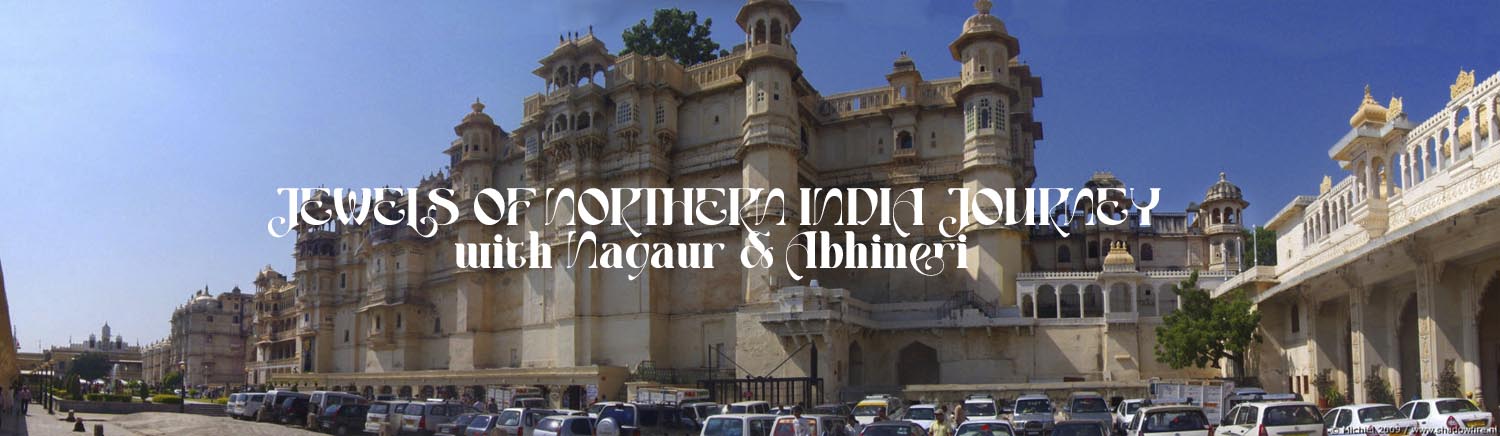
Today, after enjoying a delicious breakfast in the Jharokha Restaurant with views of the lake and its splendid surroundings, explore the captivating city of Udaipur. Your first stop is the majestic Udaipur City Palace, situated above Lake Pichola. This is the largest palace complex in Rajasthan. The Maharanas of Mewar had their original capital in the present-day pilgrimage town of Nagda, 30 kilometers or 19 miles north of Udaipur. It was established by the 1st. Maharana, Guhil, in 568 CE. In the 8th. century CE the capital was moved to Chittor, where the successive Maharanas built the largest Fort and city in contemporary India. Already before the sacking of Chittorgarh by Mughal Emperor Akbar, in February 1568 after a long siege that began in October 1567, the plans for a new capital were under way. The construction of the Mewar Dynasty’s City Palace in Udaipur started in 1559 by Maharana Udai Singh and continued by his successors over a period of about 300 years. Today the visitors see the Mardana (male section) and Zanana (female section) of the museum part of the palace. Apart from these two others sections of the palace are converted in to hotels: “The Shiv Niwas Palace” and “The Fateh Prakash Palace” are now managed by the famous Taj Group of Hotel, who already managed the historic “Lake Palace Hotel. The descendants of the Maharanas of Mewar still reside in one section of the palace.
Walk in front of the City Palace through the Tripolia (3-arched royal entrance) to Jagdish Temple constructed by Maharana Jagat Singhji in 1651, for sightseeing. Dedicated to Lord Vishnu, this is the largest and most splendid in Udaipur, offering a glimpse into the city’s religious heritage. As you drive past Fateh Sagar Lake, relish the Sahelion-ki-Bari, also known as the “Garden of the Maids-of-Honor”. This enchanting garden boasts delicately chiseled kiosks, fountains, and elephants in its four pools. It’s the perfect place to soak in the serene beauty of Udaipur.
The boat ride on Lake Pichola offers a delightful experience of sailing past picturesque Ghats (steps leading down to the water) and palaces. As you cruise along the tranquil waters, you’ll witness the majestic beauty of Udaipur’s famous landmarks, such as the City Palace and Lake Palace, which appear to float on the lake’s surface. One of the highlights of the boat ride is a stop at the island of Jag Mandir, a magnificent 17th-century water palace. This island palace provides a captivating glimpse into the royal heritage and architecture of Rajasthan. It’s a serene and enchanting journey that allows you to immerse yourself in the splendor and history of the lake city. Dinner and overnight will be in Taj Lake Palace Hotel.
After breakfast in the Taj Lake Palace Hotel drive through the Aravali Mountains to the medieval Chowmukha Jain Temple (4 sided temple) that was built in the 15th century. It is dedicated to Lord Adinath Bhagwan (the first Thirthankar or teacher of Jain religion). It is renowned for its intricate architecture, particularly its 1,444 unique, intricately carved marble pillars, a stunning example of Jain craftsmanship that adorns the numerous halls and domes. A notable feature is a deliberately crooked pillar, a reminder of the imperfection of all things.

After sightseeing and lunch in Ranakpur, drive further to enliven the majesty and grandeur of Jodhpur, the erstwhile capital of Marwar kingdom.
On arrival check-in to Taj Umaid Bhawan Palace Hotel. The Marwar Maharajas moved from the Mehrengarh Fort when they constructed the new Umaid Bhawan Palace in 1943. Maharaja Umaid Singh laid foundation stone of the 347-room palace in 1929. Henry Vaughan Lanchester, a contemporary of Sir Edwin Lutyens, the planner of British East India Company’s capital at New Delhi, was selected as the architect. Lanchester designed the building blending western and Indian architectural features referred to Beaux Art or Indo Deco Style. One part of the palace is managed as luxury heritage hotel call Taj Umaid Bhawan Palace, in another part the present owners live while a third part has historical museum open to public. This is first building in India to have an electric operated elevator.
The Polish artist Stefan Norblin painted the murals in the Umaid Bhawan Palace Hotel, working on the palace between 1944 and 1946 for Maharaja Umaid Singh. Norblin created a collection of murals depicting Hindu epics, gods, and animals in the palace’s Art Deco-style interiors, which feature a blend of European modernism and traditional Indian architecture. His murals in the palace feature scenes from the Ramayana: Hindu gods like Shiva and Parvati and the goddess Durga, as well as various animals such as tigers, leopards, and elephants.
Dinner and overnight in Taj Umaid Bhawan Palace Hotel (heritage 5-star deluxe hotel).
After breakfast sightseeing of the exhibits and palaces in Mehrengarh Fort and Jaswant Thada Memorial of former Marwar Maharajas. After lunch visit the Umaid Bhawan Palace Museum.
Mehrengarh Fort, an amazingly constructed royal residence perched on the lone mountain surrounded by the desert plain. From top it surprises the visitor with panoramic views of the blue city below. The buildings inside the fort are intricately yet beautifully designed. The interiors of the palaces are covered with colorful paintings with lots of gold foil decorations. Each section is unique in its design. These palaces are so very different from the palaces in other former Rajput capitals.
Half way up the mountain on which the fort is situated is a grand white marble memorial for the former Maharajas of Marwar. The Jaswant Thada Memorial was constructed by Maharaja Sardar Singh to commemorate and honor his father, Maharaja Jaswant Singh I in 1899. The building offers unique latticed screens The interior of the memorial is decorated with intricate carvings, latticed screens and colorful frescoes.
The center of the city is the grand Clock Tower with a bustling bazaar around it with vendors selling fragrant spices and perfumes to colorful cloth material merchants. The streets are full of all different modes of transport ranging from camels and horses to bicycles, pedal rickshaws, scooters, autorickshaws, cars, vans, and variety of mini- and large coaches. Cows are holy, they can block any passage or roads and everyone goes around them if they can!
After sightseeing of Mehrengarh and Jaswant Thada Memorial you will be transferred to the domestic airport to board the Air India AI2476 departing at 3 PM and arrive in New Delhi at 4.25 PM. Transfer to Holiday Inn Airport City to relax and later farewell dinner.
Around mid-night transfer to Indira Gandhi International Airport Terminal 3 to board the Air India flight back to San Francisco. Subsequently transfer by coach from San Francisco Airport to Fresno.
Additional Information:
Included hotels in this luxury tour are:
| CITY | HOTEL | ROOM CATEGORY | # of Nights |
| NEW DELHI | Taj Mahal Hotel | Luxury Room | 2 |
| KATHMANDU | A Loft Hotel, Thamel | Guest Room | 2 |
| NAGARKOT | Club Himalaya Hotel | Guest Room | 1 |
| AGRA | Oberoi Amar Vilas | Premier Room | 2 |
| JAIPUR | Taj Jai Mahal Palace | Palace Room | 2 |
| MUMBAI | Taj Mahal Palace & Tower | Palace Room | 1 |
| UDAIPUR | Taj Lake Palace Hotel | Palace Room | 2 |
| JODHPUR | Taj Umaid Bhawan Palace | Palace Room | 1 |
| NEW DELHI | Holiday Inn Airport | Farewell dinner |
Included in the price of
US$ 9,990.00 with economy class airfare
or
US$ 12,690.00 with business class airfare for international sector
and
US$ 4,940.00 for single hotel room occupancy:
- Roundtrip international airfare from Fresno to New Delhi (nonstop/direct flight from San Francisco to New Delhi) not included in Indian Agent’s Quote.
- 13 Nights’ accommodation in double/twin Room at all 5-star hotels/ Lodges as mentioned in program
- All transfers & overland trips by Air-conditioned Luxury Bus
- Mineral water, Juices & soft drink coca cola during sightseeing and overland trip
- All current taxes as on date
- All entrance fee at monument as per the above itinerary
- Domestic flight Delhi / Kathmandu / Delhi, Jaipur / Mumbai / Udaipur, Jodhpur / Delhi in normal economy class
- Breakfast and Dinner in hotels & lunches will be in exclusive city restaurants during sightseeing
- English speaking / accompanying guide throughout the tour
- Exclusive visit to the “Chandra Mahal” present Maharaja of Jaipur’s residence in City Palace
- An Elephant ride in Jaipur
- Boat ride in Arabian Sea in Mumbai
- Boat ride in Udaipur
- Horse Tonga ride in Agra
- Rickshaw ride in old Delhi & Jaipur
- Auto-Rickshaw (Tuk tuk) ride in Jodhpur
- All applicable taxes
Not included in the price:
- India Visa Fee – US citizens require their passports to be valid for six months after return date from India. Visa for travel to India can be applied online at: https://indianvisaonline.gov.in/evisa/Registration
- Mountain Everest flight in Kathmandu (USD 300 Per person) weather permitting
- Any change in tax structure resulting from the hike in published tariff
- Any video / still camera fee to the monuments and places of visit
- Any other item not explicitly mentioned under price includes
- Any Insurance
- Any personal expenses like Tips, Telephone calls, laundry, phone calls, room service & alcoholic / non-alcoholic drinks (other than in coach)
Payment:
Payment by personal check in favor of INDIA TRAVELLER as per agreement with you after you approve the itinerary or by Paypal